

[For email subscribers: my dearest apologies for the duplicate email. Major domain problems erupted at the same time I first published this piece, and I have no idea if the first was received or if any of the links, visuals, etc. for the first worked, if it was received]
.
How do you organize people?
I’ve Tackled the topic of Dissident organization before with my deep dive in to how the left and the Regime actually organize: Can you Organize Your Way Out of Tyrrany? And I’ve deep dived why traditional conservatism and Libertarianism fails to reflect political reality in The Goyslop Ideology: The Lie of Libertarianism, and I’ve vehemently defended the roles of Discrimination and Fanatical Rage as core organizing forces in Discrimination is a Right and Cry Havoc and Bray for Blood: On the Importance of Womanly Screeching.
But how do you actually organize people?
Specifically how do you organize people to work and fight together, to identify with a team, an ethnicity, an organization… To the point where they will gladly incur major costs, exert extraordinary effort, risk their reputations and fortunes, and even kill and die for it, above and beyond any reasonable expectation of timely compensation?
How do you get people to fight and die for a cause whose price and consequences are as immediate and inescapable as grapeshot or shrapnel artillery in an open field, and whose rewards are as tenuous, faint, and distant as a homeland for yourself and your relatives decades later? A happy childhood for your grandchildren? The esteem and reverence of your neighbors in old age?
When your nation is in poverty or shame and the utter LACK of rewards for Veterans, Patriotic Volunteers, and fanatical partisans is as plain and in your face as as the veteran beggar asking for change? (as indeed almost every nation has witnessed across the centuries)
How do you motivate people? how do you organize?
Well if you’re white, the answer hasn’t changed in 3000+ Years.
You erect idols. You practice literal idolatry.
.
The First Masks of Command
Going back to the walls of Troy various divine symbols can be seen being used to rally troops.
In the Iliad these are rather unique… In the Iliad these ARE Gods. More specifically they appear to be people in costumes and masks.
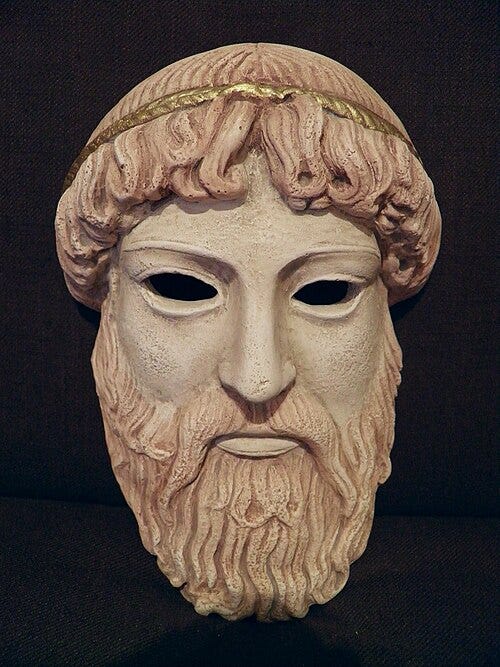
Many people interpret this direct participation of the Gods in battles, that this is Homer’s magical thinking and an insight into the Psychology of Dark Ages Greece (the post bronze age dark ages, 1100bc-600bc)…
But if you read Homer it becomes very apparent that more is at play. The Gods give speeches to armies and ride chariots beside the kings, shouting encouragement and rallying troops and having a major effects on the crowd dynamics of the battle.
In case it isn’t obvious, psychological representations don’t move crowds of people at once… Your psychology is inner not outer, they don’t affect other people, at least not immediately. And while sometimes the Gods might represent inner thoughts: such as when Odysseus or Achilles are alone and contemplating when a God appears, or whispers in their ear at a choice moment that only they hear (which is a neat dramatic device, sorta like how Shakespeare uses monologues). That’s simply not how Gods behave in the battles of Homer… And no they don’t behave like embodiments of crowd momentum or the fury of fighting, or divine favor.
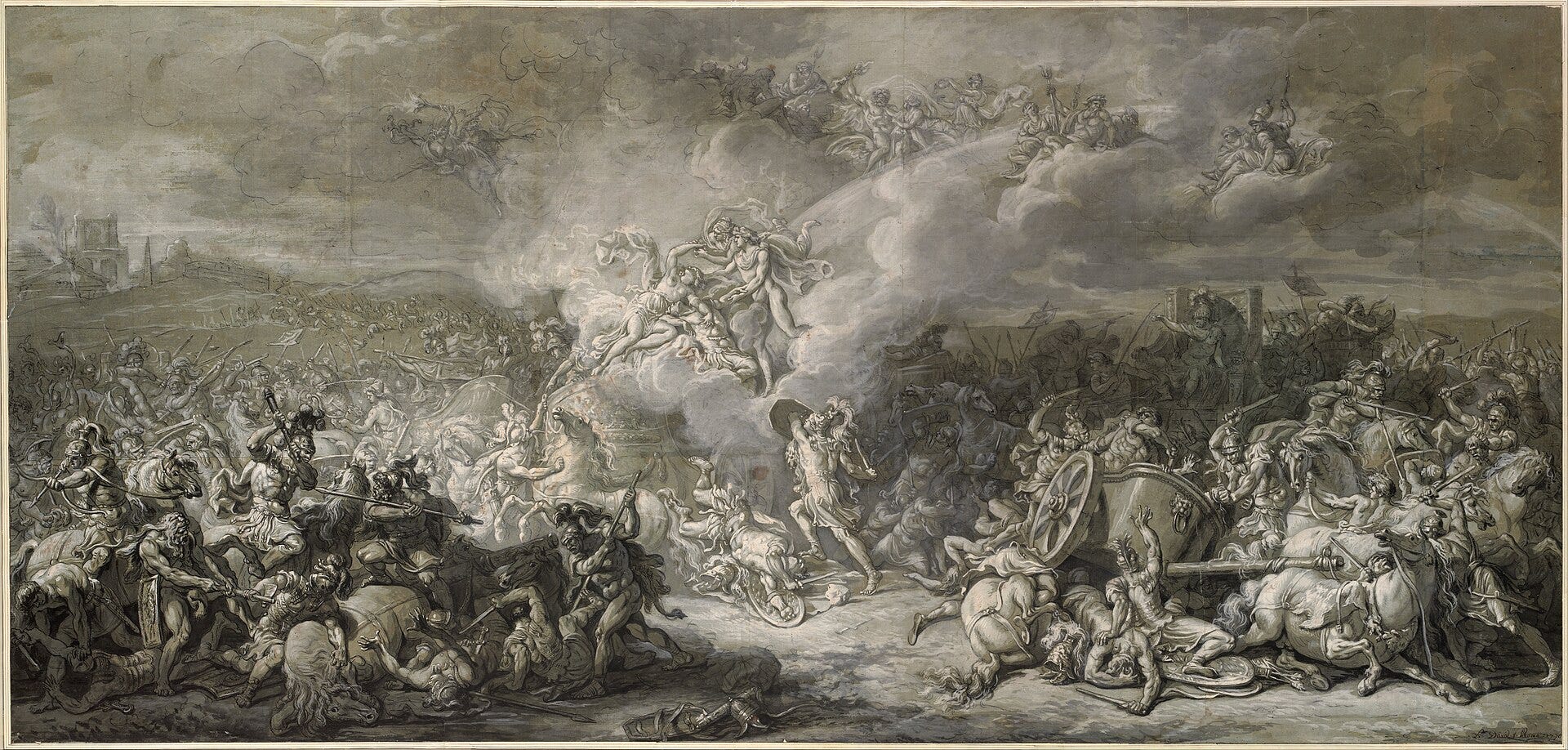
In Book 5, “Diomedes Fights the Gods” the Greek Hero Diomedes refuses to accept the Trojan Prince Aeneas escaping his fight with him, Diomedes press forward for the kill. At which the Love Goddess Aphrodite rushes out of the ranks of the Trojans to shield and assist Aeneas away with her shawl and other objects acting as distractions and cover… And Diomedes striking towards Aeneas cuts her with his spear. He cuts the divine perfect white flesh of beauty and love herself!
Does Diomedes pay a horrible price for shedding the blood of an immortal Goddess? Does Aphrodite smite him or curse him with some terrifying love-doom?Does this forever alter the very nature of beauty such all beautiful women spout scars in the very spot, which we now know as some incredibly sexy or disgusting universal feature of the female form? No she is just cut and cries out in pain… Like a person.
At which the other Trojans have time to intervene, and both Aeneas and Aphrodite successfully extract themselves.
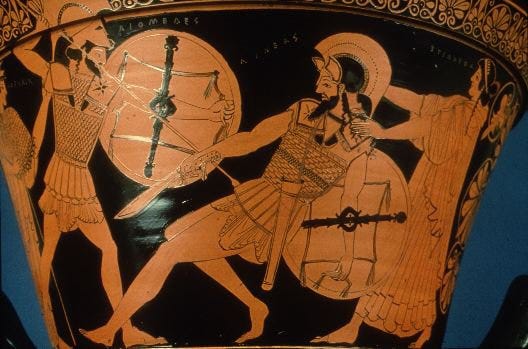
Later in the same battle Ares God of War and Slaughter takes personal leadership of an offensive by the Trojans again the Greeks carving an opening and cutting down several soldiers…
At this Athena, Goddess of Cunning, War, and Wisdom admonishes the Greek leadership that they do not simply STAB the Deathless God of Merciless Slaughter, that spearing the very Divine Embodiment of bloodlust and slaughter was a seemingly trivial thing and that she was disgusted no one had done it already.
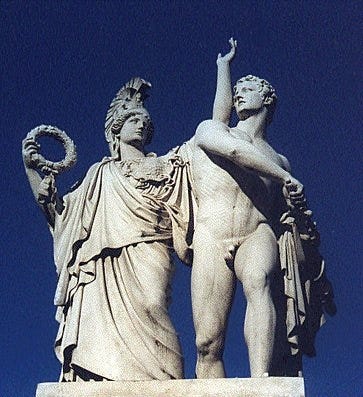
To this Diomedes replied, NOT that defeating the God of War himself in single combat seemed like a tall order for a mere mortal who wasn’t even the best in Greek army. But rather that he would and wanted to, except that he had always heard that it was bad luck and bad form to fight with or target the Gods on the battlefield, and this was common knowledge. King Agamemnon nodding beside him.
At this Athena catches herself in the midst of her excitement, and explains patiently that while they are certainly correct that NORMALLY one should not fight with the Gods or target them directly… and that USUALLY it is bad luck and ill form, and strongly looked down upon…
Ares himself has violated this elaborate etiquette, and so it was perfectly acceptable for Diomedes to spear the Immortal God of War… something none of the 3 of them doubted Diomedes could do quite easily.
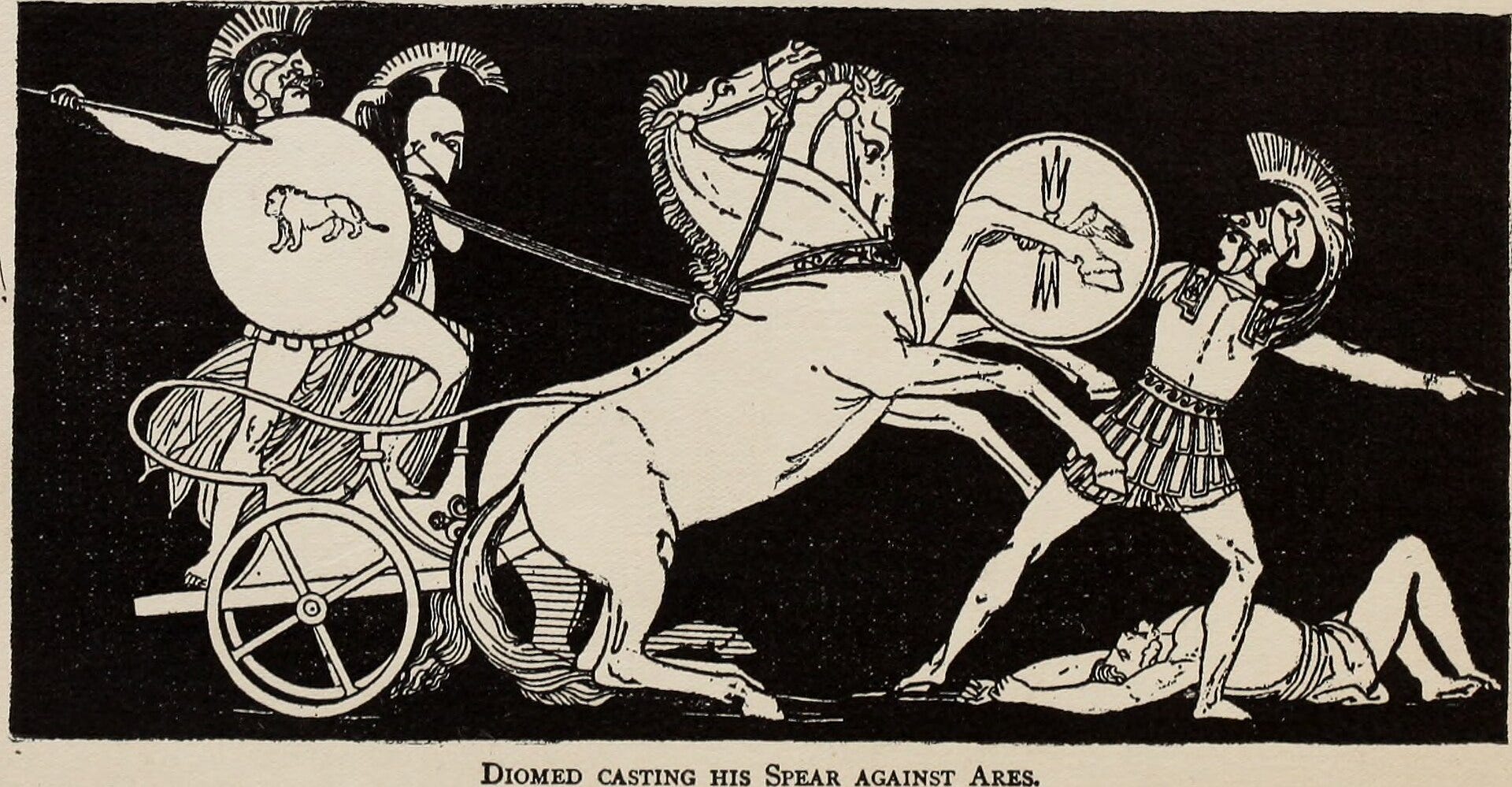
So Diomedes does this. Rather trivially… At which Ares falls back immediately on the first hit, slain through the belly, and then magically appears immediately on a couch in Olympus, complaining his wound will take time to heal, where Zeus admonishes him for his poor behavior.
Does this broaden Diomedes reputation? That he can fight the Gods themselves and live? Not really… It is treated more as a cute story, remarkable in that Diomedes comes away with his reputation and esteem intact, NOT that this wildly improves others’ estimation of him as a fighter, that he can even take the God of War himself, and that they now need to reassess his skill relative to Ajax, Odysseus, and Achilles.
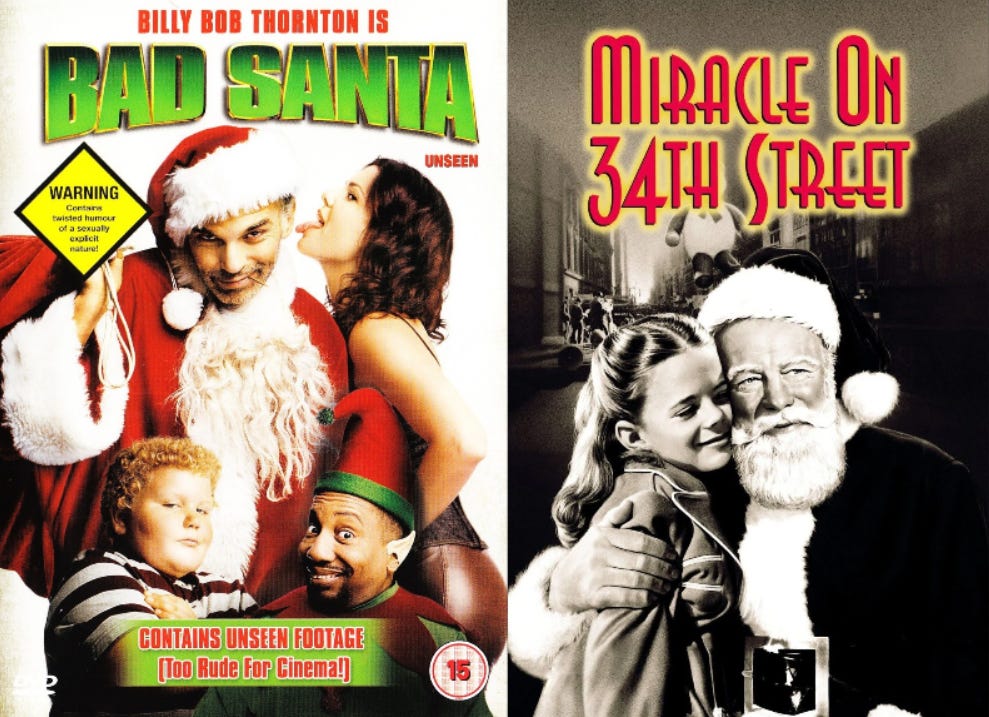
This is of course Mall-Santa logic.
Diomedes does not get cursed or lose his ability to fight forever, or get doomed to be the first of some horrifying perversity for assaulting Aphrodite and Ares, nor does he ascend and become the New God of War, and take Beauty herself as war plunder, having surpassed even Ares himself in the unstoppable strength of his war-making… and driven the perfect woman to whimpering flight.
In the same manner that in many American folk tales and films a drunken or disgraceful Mall-Santa, a guy in a costume, might initiate a shouting or insult match with a child… and neither the child, the audience, the parents, or the child’s friends might be over-concerned that this will impact the Child’s ever getting Christmas presents again, or that “Santa” being arrested for public drunkenness might cause Christmas to be cancelled.
They know it will have no such consequence, with it being funny or cute if an over-earnest child needed reassuring that everything was fine afterwards.
.
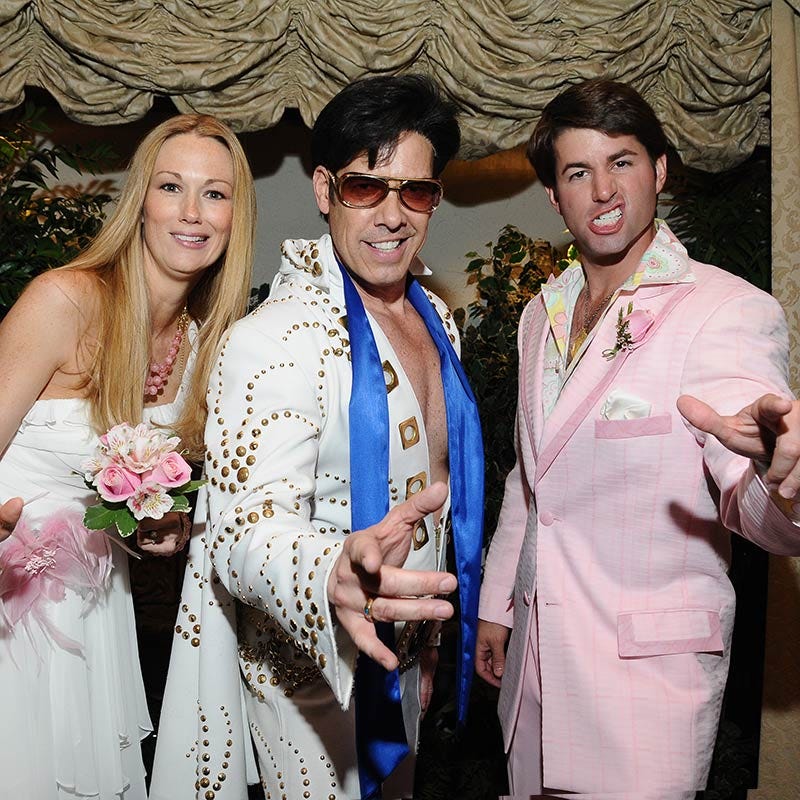
In much the same manner that modern Americans conceive Santa Claus or the Easter Bunny or Elvis Impersonators or Disney Princesses in the Theme Park… A bad actor or poor player in the priestly garment might warrant censor and scorn, whereas a good actor might be equated with the magic of the figure such that the sentimental might not wonder that the true immortal magical figure hasn’t visited them. That your parents were maybe wed by the REAL immortal Elvis, the King of Rock and God of Graceland, in the clever disguise of an ordinary Elvis impersonator… that the wedding went so well.
Americans in the 20th century have even gone vastly further and started doing straight Greek Style theatrical productions of the Life of Jesus, with various nativity and passion plays now being a staple of American life.
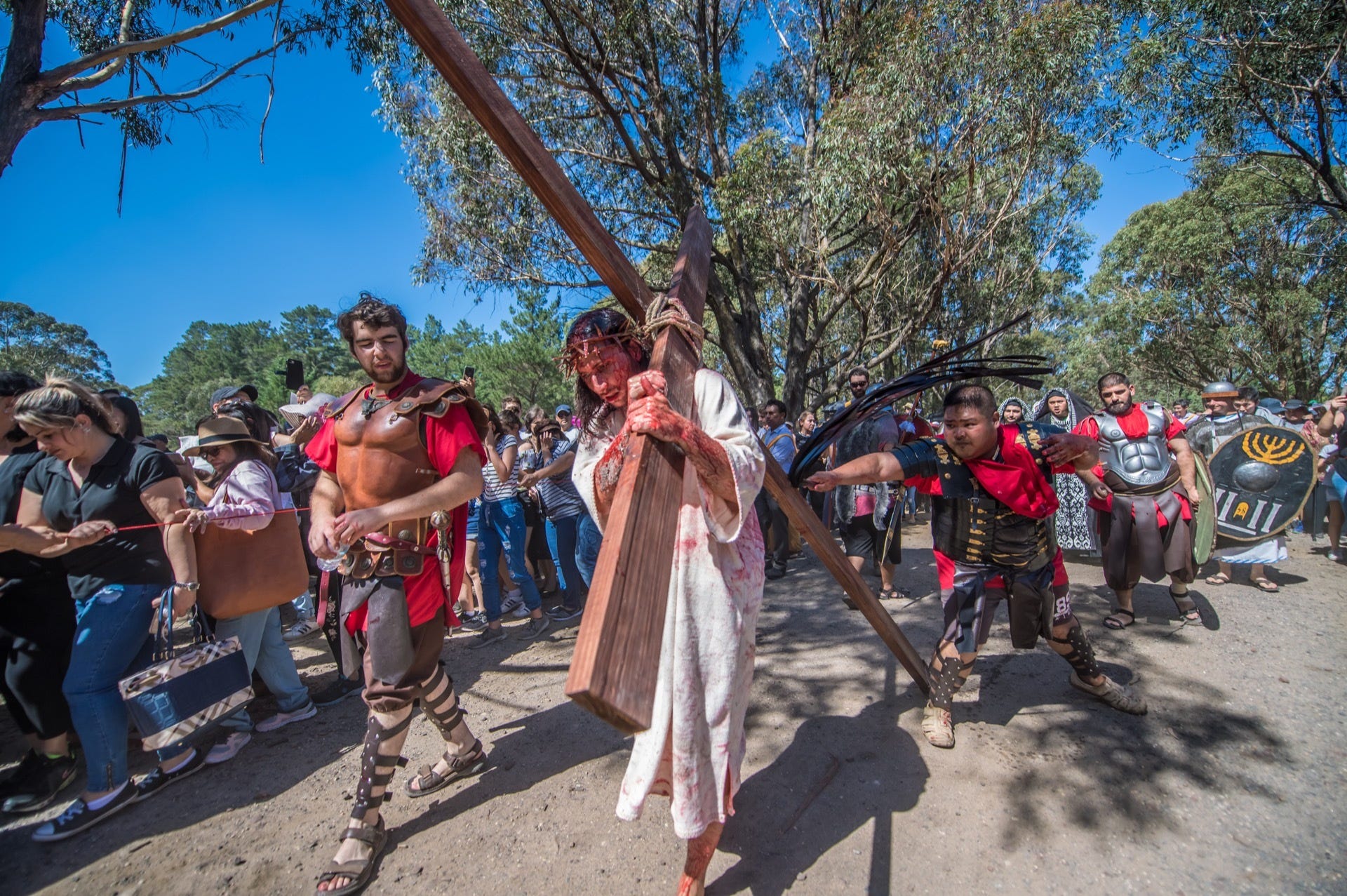
Indeed we have several examples of the Actors playing the Gods being themselves named and praised for their conduct.
In book 13 of the Iliad the Greeks desperately defending from a Trojan assault against their very ships are assisted by Poseidon…
Poseidon’s entrance is described divinely and magically enough:
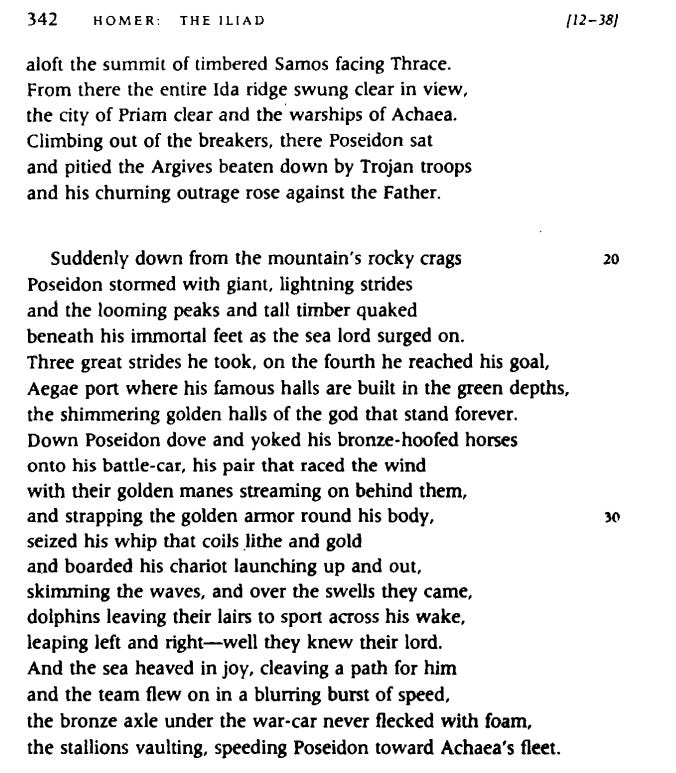
Wow he strode from A mountain in Samos across the Aegean sea to Aegea Port in FOUR STRIDES? He’s 200 miles tall!
What divine power is he about to unleash on the Greeks? How many Trojans are going to die to this Giant of Giants? What great assistance must he give the Greeks?
Well he gives them a pep talk:
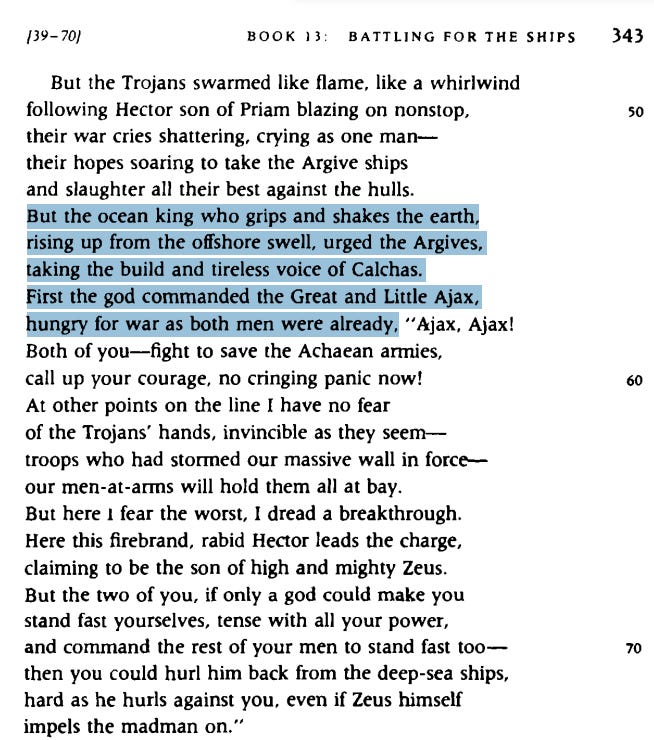
That’s really disappointing and would, you’d think, be rather lame relative to that massive setup… But notice the specific line “Taking the build and tireless voice of Calchas”…
the bigger and slimmer Ajax comment on this:
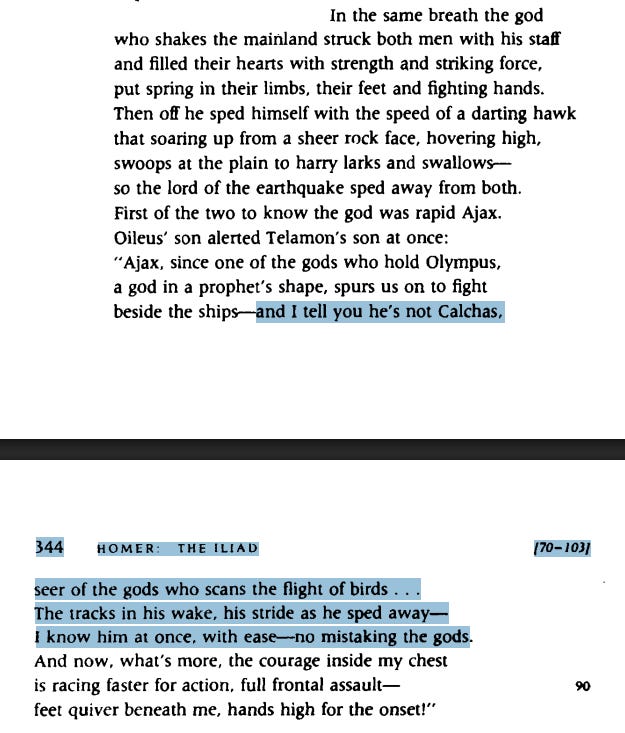
Little Ajax (Oileus’ son) commentates that he can tell the person in the mask and outfit is clearly the form and voice of Calchas… but that the person before them has such divine authority about him and is saying so rightly what they must do, that it cannot be but the God Poseidon himself, in the guise of Calchas.
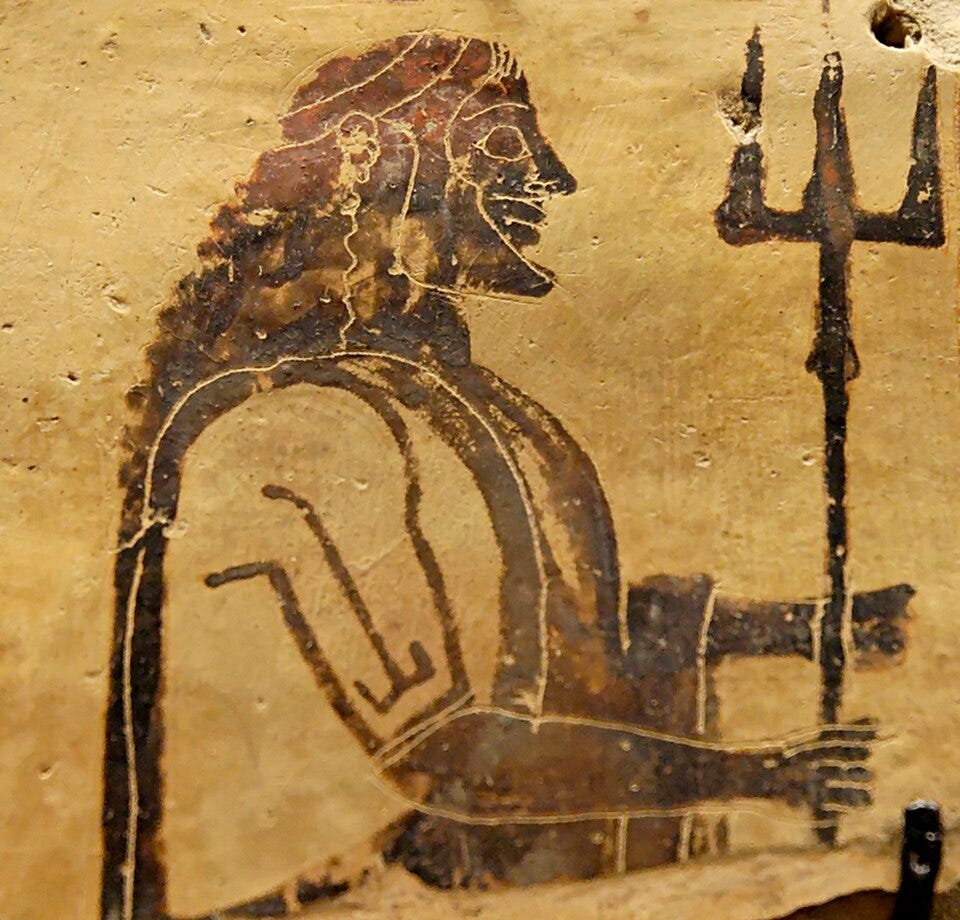
Unlike “Aphrodite” or “Ares” who fought for the Trojans, the Greeks can tell WHO is playing Poseidon… and because he does such a good job they have to play this word game where they really want to praise the individual priest for his heroic conduct in rallying the army at it’s lowest… but not break the spell by saying that it is not Poseidon.
A word game and praise that survived either from Troy, or some other battle whose episode Homer thought worth immortalizing and so incorporated into his Poem.
This speech by “Poseidon in the form of Calchas” sets off a chain of various figures and heroes rallying the forces of the Greeks against the Trojan onslaught, with the Ajaxes, Poseidon, and other leaders rallying the failing Greeks, such that they are able to repel the Trojans and save the ships.
Much as for thousands of years after individual drummer boys or flag bearers or Sergeant Majors or priests of various faiths and various symbolic leaders like Boudica or Jean D’Arc have been able to turn the course of battles by their individual displays of courage or the rallying effects of their voice… Calchas, or “Poseidon in the guise of Calchas” was able to save the Grecian Fleet.
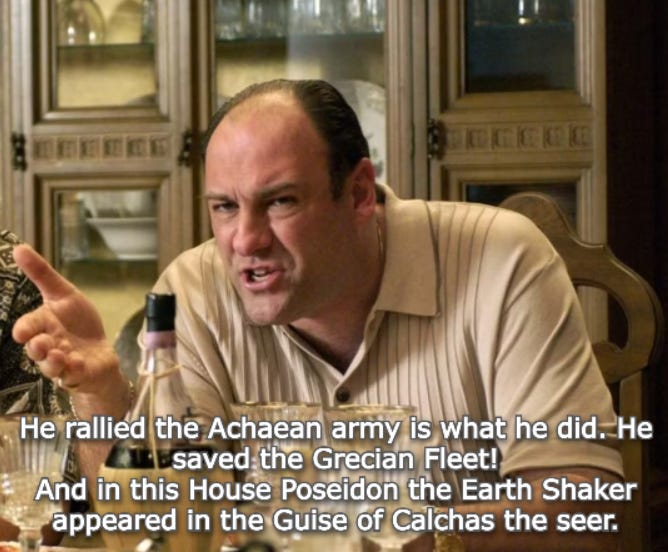
Indeed long after this had stopped being a battlefield tactic to rally troops, we see such religious masks and acting in the Athenian theater and religious festivals, with Athena or other Gods closing out plays about vengeance or other intractable plots by being lowered into the theater on Great pully machines to resolve the story with a miracle… Not theatrically differently than how passion plays now end with Christ and others being lifted on the exact same theatrical wires into the sky.
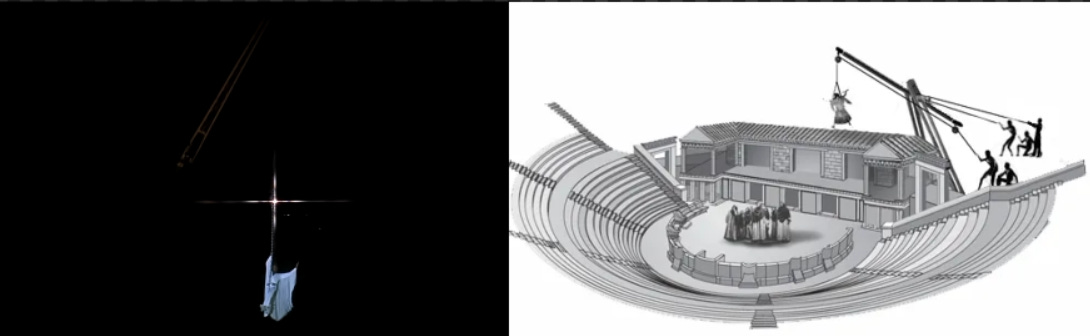
.
Indeed we have an example of the missing link between the two Greek traditions… An almost perfect snapshot of the Priests rallying soldiers on the field of battle being transformed into the later theatrical festival tradition.
In the Histories of Herodotus we have an almost perfect example of just such Godly costumes being used in military and political theater when the Athenian tyrant Peisistratos returned from his first exile employing a extraordinarily tall woman to play the role of Athena leading him back to Athens as it’s rightful ruler:
Thus Peisistratos had obtained possession of Athens for the first time, and thus he lost the power before he had it firmly rooted. But those who had driven out Peisistratos became afterwards at feud with one another again. And Megacles, harassed by the party strife, 69 sent a message to Peisistratos asking whether he was willing to have his daughter to wife on condition of becoming despot. And Peisistratos having accepted the proposal and made an agreement on these terms, they contrived with a view to his return a device the most simple by far, as I think, that ever was practised, considering at least that it was devised at a time when the Hellenic race had been long marked off from the Barbarian as more skilful and further removed from foolish simplicity, and among the Athenians who are accounted the first of the Hellenes in ability. 70 In the deme of Paiania there was a woman whose name was Phya, in height four cubits all but three fingers [5’11” stupendously tall for a woman in 550bc], 71 and also fair of form. This woman they dressed in full armour and caused her to ascend a chariot and showed her the bearing in which she might best beseem her part, 72 and so they drove to the city, having sent on heralds to run before them, who, when they arrived at the city, spoke that which had been commanded them, saying as follows: “O Athenians, receive with favour Peisistratos, whom Athene herself, honouring him most of all men, brings back to her Acropolis.” So the heralds went about hither and thither saying this, and straightway there came to the demes in the country round a report that Athene was bringing Peisistratos back, while at the same time the men of the city, persuaded that the woman was the very goddess herself, were paying worship to the human creature and receiving Peisistratos.
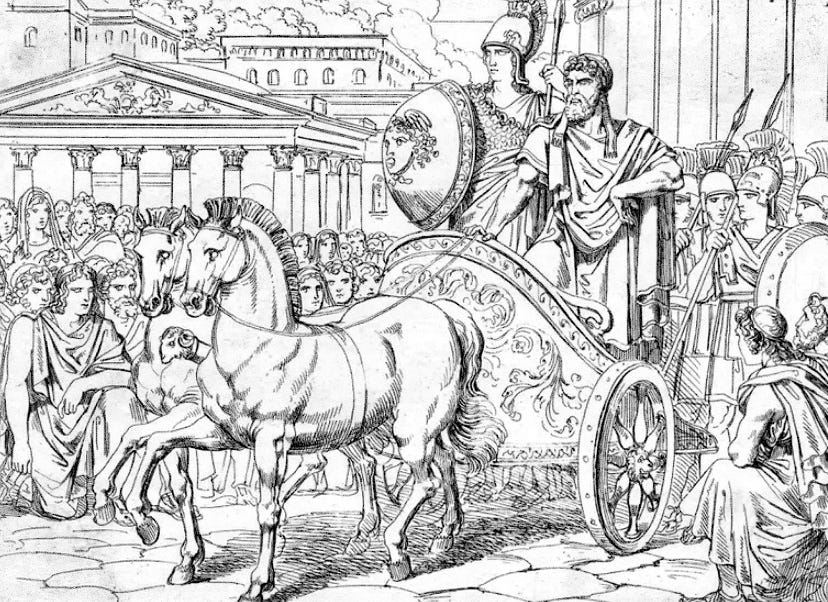
I cannot emphasize enough that this episode is found not only in Herodotus, but also Aristotle and Cleidemus (via other works referencing him)… This happened… despite the effort of many subsequent authorities to dismiss it.
Although contrary to the incredulity and outrage of Herodotus, Aristotle, and a good chunk of all the subsequent historical commentators to this day, “The Athenians fell for that!?”… This makes vastly more sense when you realize the Greeks have an extensive tradition of priests, seers, and other figures taking on the guises of Gods (or Gods taking on the guises of mortals) and using them as living symbols and banners in matters military and political. Pisistratus’ life occured almost exactly at the transition period of the rise of Hoplite warfare and the decline of this earlier Homeric mode of war and politics.
.
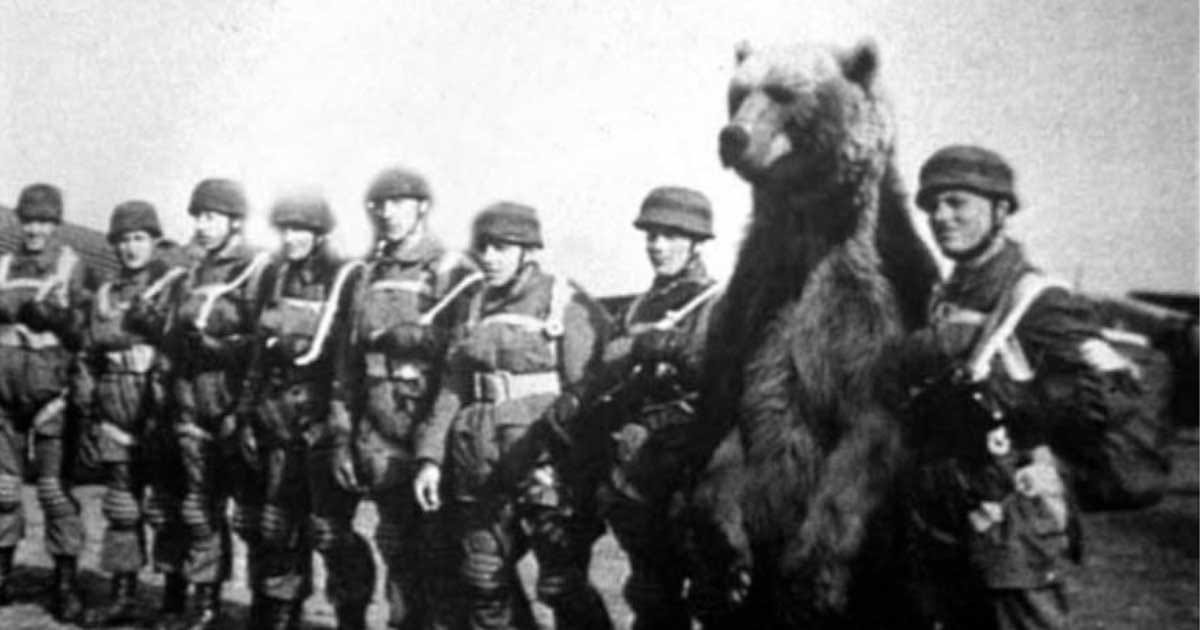
Indeed such living banners and their dramatic morale effect, whether in the form of adolescent drummer boys, “Warrior Queens”, Crusader Priests, or Literal Bears and other animals, have cropped up again and again on the battlefield.
.
.
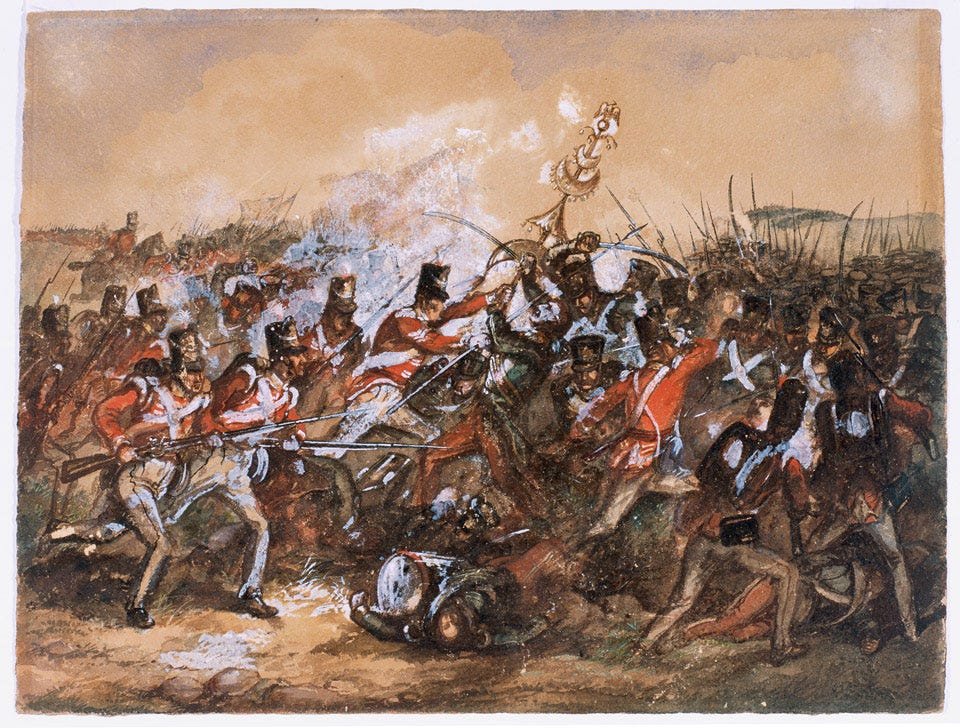
The King’s Colours, Rise of the Eagles
While we can find many subsequent examples of living banners and the heroic morale effects such Gods, Boy Kings, Chaplains, Commissars, Berserkers, Sorcerers, and animal mascots are often able to draw from soldiers…
As command structures centralized into unified formalized and disciplined armies became the standard for militaries, and warlord bands like the Achaeans where a mid level commanders such as Achilles might refuse to fight over personality and honor clashes with a King became rarities on the battlefield…
Suddenly the symbolic morale effect of priests, Gods, Warrior Queens, American Congressmen, and others on the battlefield outside of the immediate military chains of command became something commanders sought to minimize outside extraordinary circumstances so as to maximize the coherence of their own authority.
.

Instead the symbolic and sacred power of the idol is concentrated instead in physical objects… Which can still be positioned and used to rally troops and held by people who shout encouragement and commands… But also aren’t tied to those individual people.
If a flag bearer or Sergeant carrying the flag (Colours) or the Legionary Eagle dies or loses his nerve and throws it down… Another member of the Unit can pick it up.
The Honor, glory and sacred bonds of the brotherhood of fighters is tied to the physical object, which itself is conveniently silent, never takes sides in any disputes, and never has a mistaken opinion.
If a cowardly leader attempts to flee with the standard, then a brave aspiring leader can simply kill them for their desertion, grab the standard, and take up the charge…
Likewise if the commander wants his troops to do something which they refuse to do out of self-preservation, then he can take the standard himself and lead the charge.
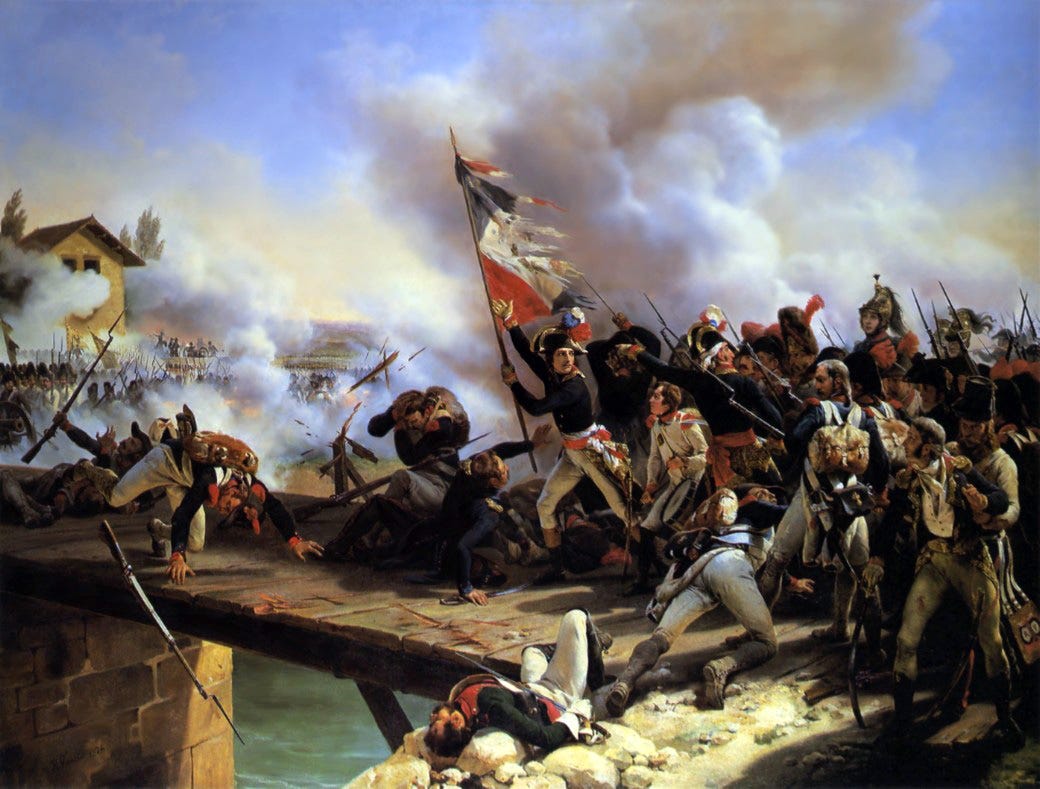
This concentration of the combined authority and honor of the organized group into a visible instantiated physical object, an idol… is truly incredible social technology because it relieves the pressure of organizing from the person of individuals.
Great Captains may be loved by their men, individuals heroes adored by their comrades, charismatic priests followed to the mouth of hell itself, individual exiled princes and princesses nigh revered as the rightful rulers of their countries, Congressmen like Davy Crocket treated as the embodiment of a dreamed republican future…
But on average, most individuals are average.
Your actual Captain is most likely a middling paper-pusher, or merely experienced officer, your heroic veterans… are usually just guys who’ve been in a while and muddled through like most, the average priest or Chaplain is shockingly uncharismatic, and most exiled princes and princesses are weirdos who can’t relate to the soldiers they find themselves amongst, and can’t ply their courtly learning in exile.
The average meeting of revolutionaries, patriots, partisans, and freedom fighters is a meeting of outcasts and social malcontents who often as not have as little reason to respect each other as the rest of society has to respect them.
Likewise the average soldier throughout history is a conscript, convict, or runaway… who finds themselves as a private, sailor, or “comrade” specifically because no one respects them.
Sure great amounts of trust, esteem, honor, reputation, and glory can accrue to these officers, revolutionaries, and fighters with time…
But almost by definition this is going to be the minority of cases and take vastly longer than most such units have.
Individual loyalty to a specific leader, hero, or figure simply is going to be the exception and depend on an almost superhuman level of esteem to get off the ground and actually create an organized unit where none exist…
George Washington could create a Continental Army in 1775, but there were maybe debatably 3 such men who could have done the same job half as well if he had not.
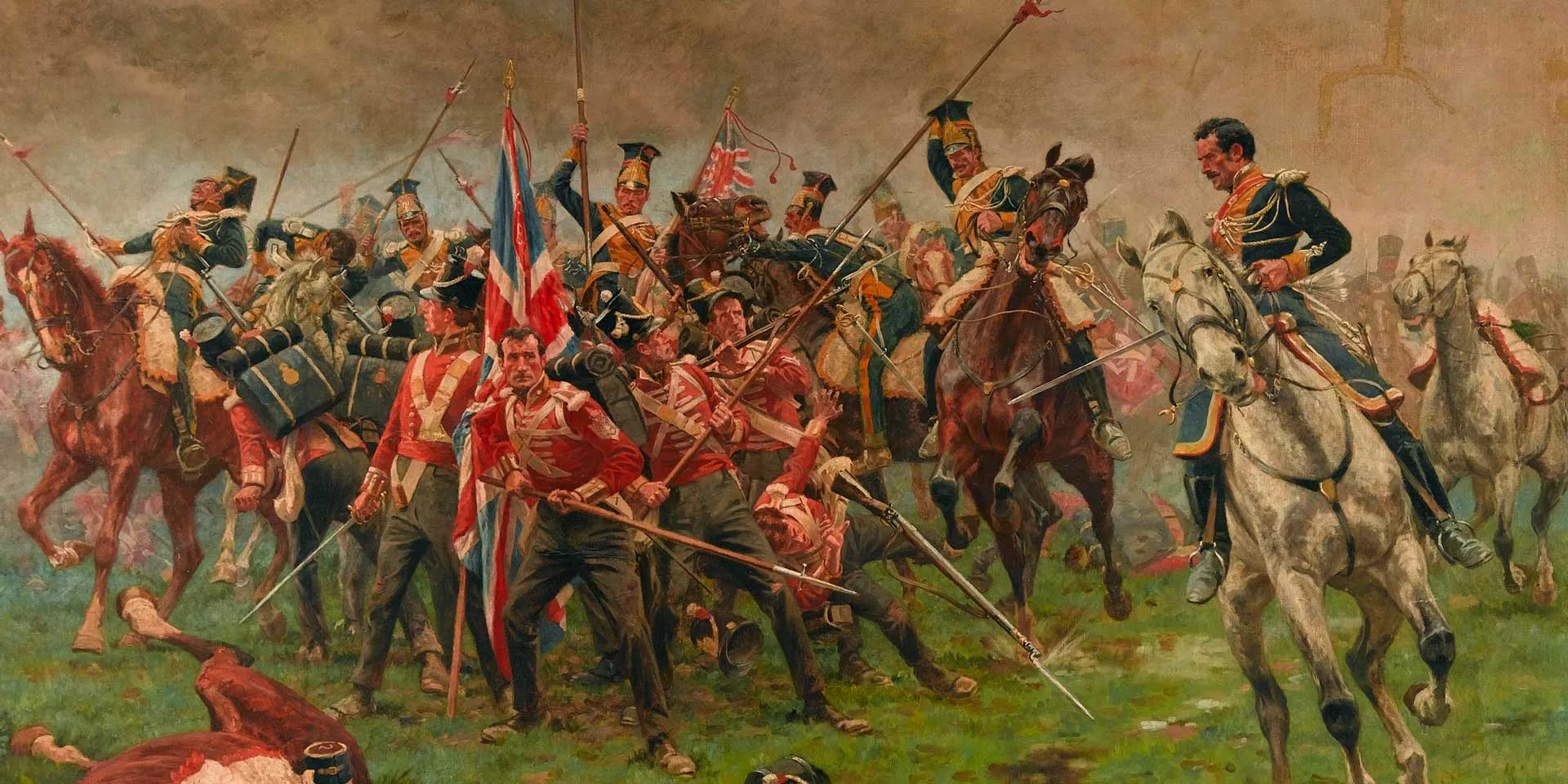
However the Colors or the Regimental eagle creates a focal point of extreme loyalty to the group that all participants can exert their mutual passion and brotherhood, without requiring their affection to be limited by the esteem a particular leader or figure can command in themselves. Fresh privates who do not even know the names of their officers can be driven to profound exertions of loyalty and pride by the sacredness their NCOs and Color Sergeants train into them for their uniforms, the Regimental Colours, and other Standards.
Men, who could not name the King, have often died defending to the last “the King’s Colours” not out of esteem for the King but rather the pride of their regiment and the honor of their comrades.
This Social Technology is the Essence of the Nation
“All forms of violence are quests for identity. When you live out on the frontier, you have no identity. You are a nobody. Therefore, you get very tough. You have to prove that you are somebody. So you become very violent. Identity is always accompanied by violence. This seems paradoxical to you?”
-Marshall Mcluhan
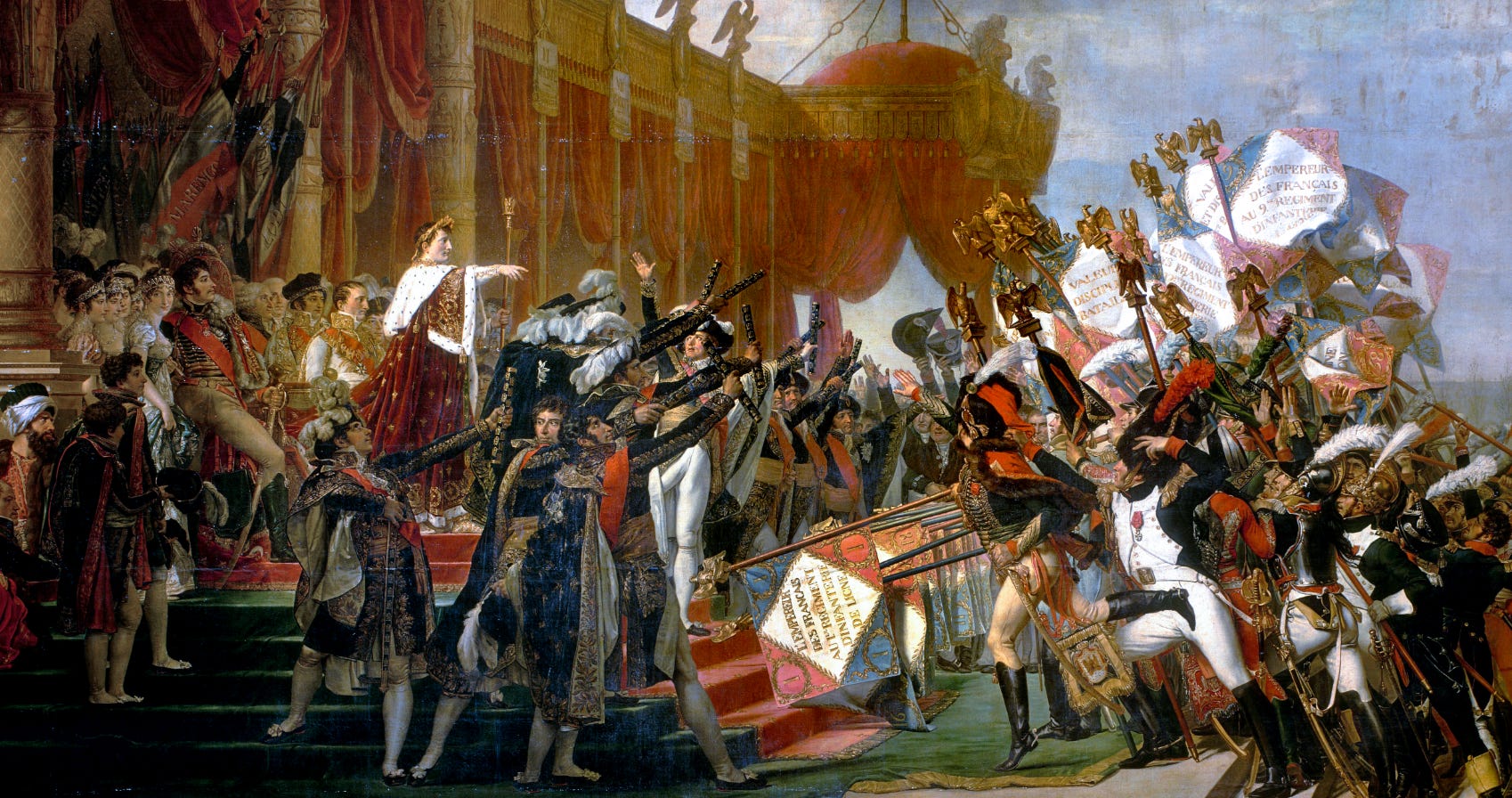
The Colors, the Regimental Eagles, the Flag… These are all IDOLS.
This is what Idolatry is.
It is organizing socially around physical objects and symbols of the tribe, the people, the nation.
.
The exact same way ancient peoples would preform sacrifices and rituals at the Monoliths and Statues of their deified founders, America and Western European countries have/had (its fading) annualized rituals in which they place sacrifices of flowers and preform rituals of honor and mourning at various Cenotaphs and War Memorials and Statues of their founders… Before likewise partaking in feasting and other rituals.
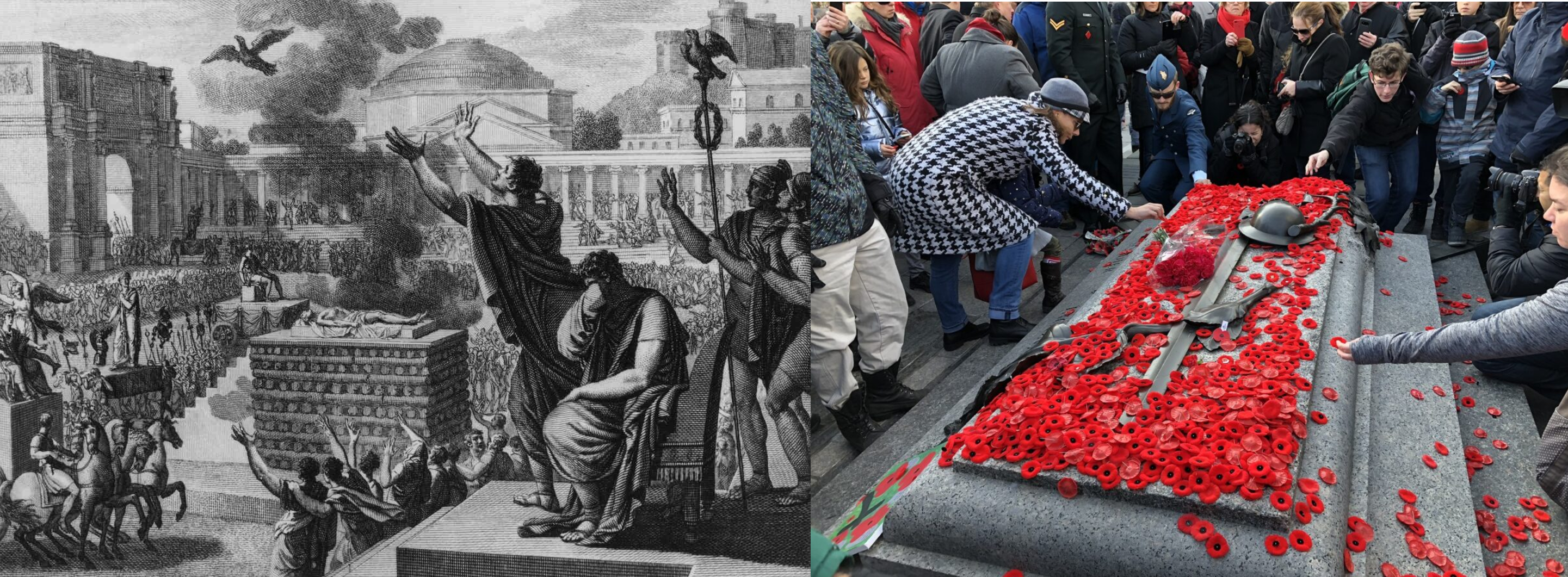
This is IDOLATRY.
It is the paying of reference to idols… Statues, Monolithic Cenotaphs, engravings, sacred sites, etc.
It is also the backbone of basically all European national identity building, internal coherence, ritual status creation, organization, internal enforcement, incentivization, sacralization, civic religion, national pride, human virtue, basic ties to the land, and basic decency.
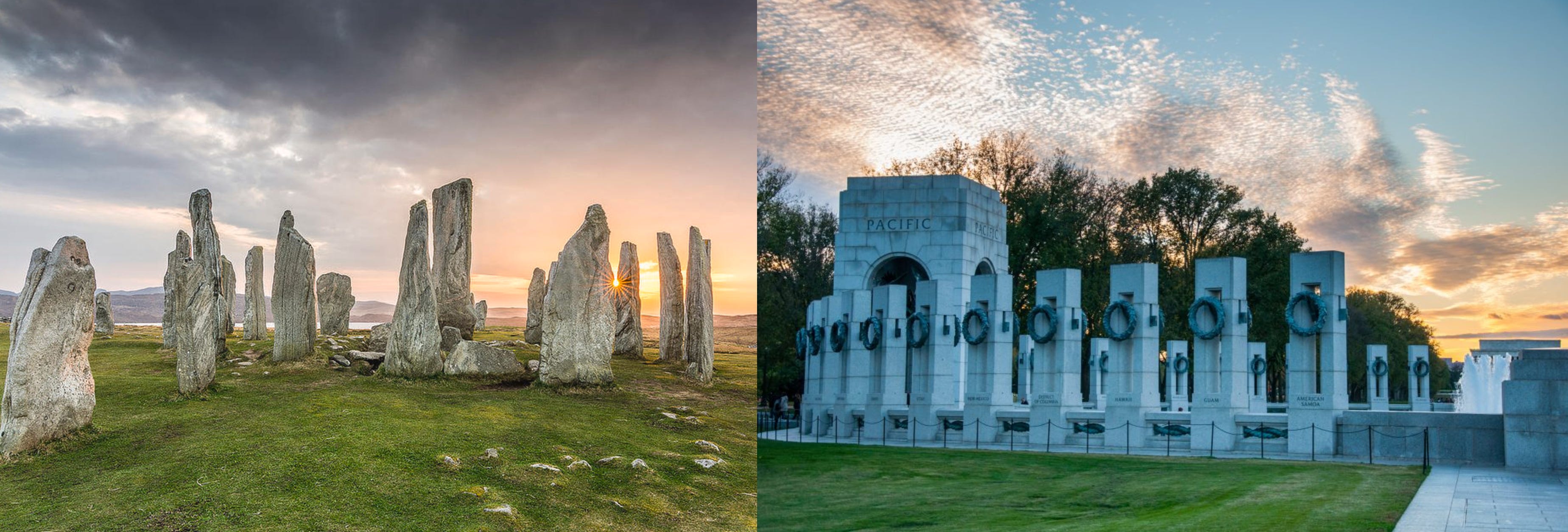
Now gee… I wonder why a very specific tribe of people who had been exiled from their lands, and had lost their identity, and defined themselves as an enemy of “The Nations” (Goyim and Gentile are often Translated as “Nations”)…
I wonder why such a people would conceive of “Idolatry” as amongst the greatest sins and define themselves in opposition to all statues, reliefs, monuments, rituals of time and place, ancestoral reverence, keeping of sacred swords and tapestries, artwork…. And Shun all martial and military glory?
.
Well ask yourself? Why do modern Communists, Leftists, Social Justice Types, etc. All connive to find some pretense to rip down statues, burn churches, deface murals, and remove monuments?
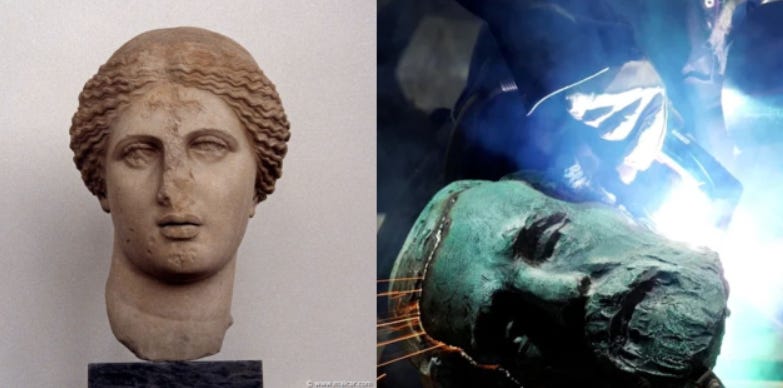
They do it not because of some theological or political pretension… these are the excuses.
They do it rather because whether it was 550ad or 2021… monuments, idols, statues, murals, flags, banners, tapestries, carvings, paintings, etc….
These Are how WHITE PEOPLE organize and orient themselves socially and spiritually. How Europeans organize, ritualize, visualize, and spiritually enforce the order and values of their societies… With beauty and glory as the ultimate spiritual enforcement mechanisms.
And Jews, foreigners, slaves, and the eternal lumpenproles that comprise the left and earlier spiteful mutant movements HATE that. They experience it as actively painful psychic damage when looking upon Statues to war heroes or Paintings of beautiful courtly life or big-breasted athletic female characters in video games in the same manner that Vampires might look upon crosses or shut-ins sunlight.
.
They can see intuitively and immediately the organization, values, social coherence, and ethnic-will expressed within these idols… The raw military, civic, spiritual, and cultural loyalty that they embody…
And so they must rip it down.
The Nations must have their idols, rituals, artwork, values, and ultimately blood destroyed since they form a powerful coherent force and set of values that excludes Jews, degenerates, foreigners, slaves, and proto-leftists in domains martial, civic, spiritual, religious, political, and sexual.
.
It is not without coincidence that the destruction of the Roman Alters of Victory and statues to the Gods almost immediately proceed the Fall of Rome.
Whilst spiritually, religiously ,and symbolically sealing or otherwise destroying the Roman Alter of Victory in 408ad seems to almost prophetically predict the 410ad sack of Rome…

If we set to one side the obvious metaphysical and portentous implications (abandoning victory before defeat), even from a purely materialistic and almost pathologically secular view it becomes obvious that Rome would suffer to defend itself, for the same reason a Regiment stripped of its colors and eagles would suffer in its military performance.
They’d lost their banner, their rallying symbosl.
This is how Europeans organize. This is how they enforce their internal coherence and values and orient and organize their loyalty.
The very fact the people in charge DESPISE the symbols and social reality of that organization and loyalty, DESPISE the symbols of the people and ethnicity enough to destroy it, should be enough to tell you that they cannot, or do not care to, defend or maintain the ethnicity itself or see it organize coherently.
.
Thus it should not be surprising that after Rome fell… Christian Iconoclasm basically stopped in Europe, not because the doctrine changed, but because the ethnic enemies of Europeans who comprised the early Christian iconoclasts: Ethnic Jews, Arabs, slaves, former slaves, foreigners, and others of the Roman urban-underclass (yes this is exactly like the US left-wing coalition)… when the Western Roman Empire fell they basically all died off for want of a centralized government to feed them out of taxes on the productive rural Roman and European population (thus why Mainland Italians still produce blondes, and gingers, and largely don’t look like the North African and Arabic slaves of the Roman Period).
And Guess what… White Europeans maintaining Christianity never really cared after that about ripping down their own Iconography, statues, heraldry, etc.
Because unlike the early Christians who were brown slaves who hated white Europeans and their art especially… White Europeans don’t hate themselves or their conceptions of Beauty, and aren’t motivated by a blinding hatred of everything that reminds them of the Grecian Conquest of Judea during the Maccabees, or Rome’s Occupation, or just white people being pretty and skilled at craftsmanship.
“You shall not make for yourself a carved image, or any likeness of anything that is in heaven above, or that is in the earth beneath, or that is in the water under the earth”
-Second Commandment NKJV
Meanwhile, The Vatican:
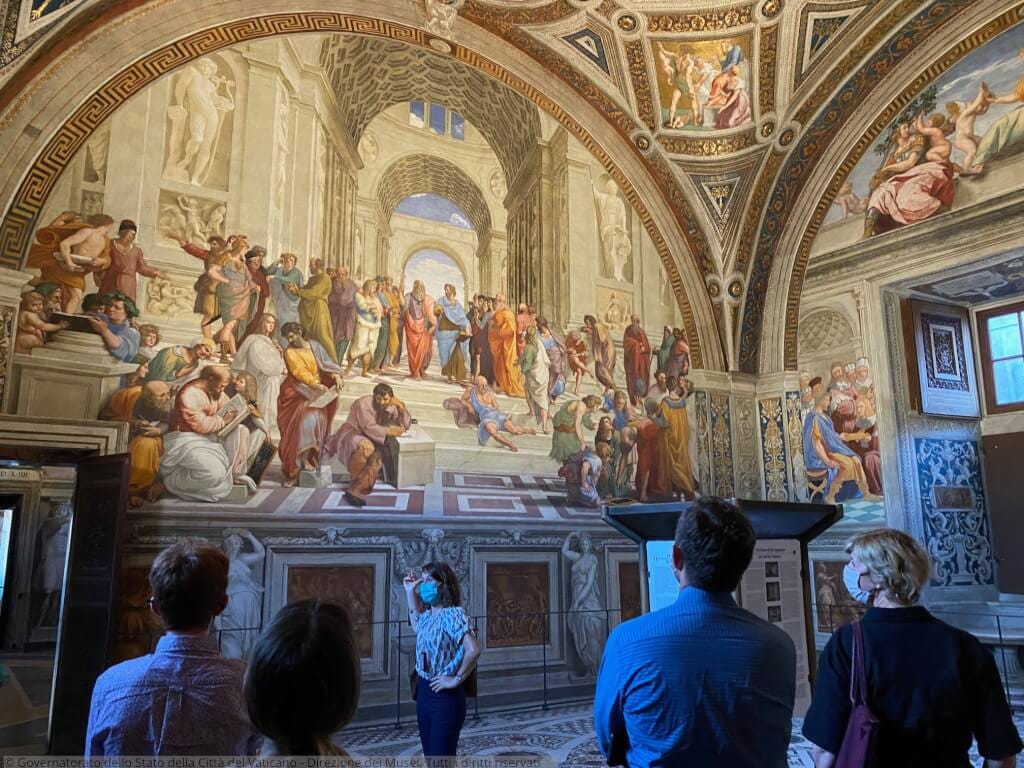
.
Whites quite like their nations and naturally build them up and make them pretty, and orient themselves towards discipline, beauty, loyalty, and reverence to their forebearers in the absence of outside subversives and moral poisons trying to dilute them and lead them away from from the natural organizing instinct found in these idols and rituals.
And even the most seemingly categorical religious commandments won’t stop even churches from celebrating that beauty and social reification in the absence of spiteful outsiders.
In Conclusion: The War on Beauty is a War On Western Civilization
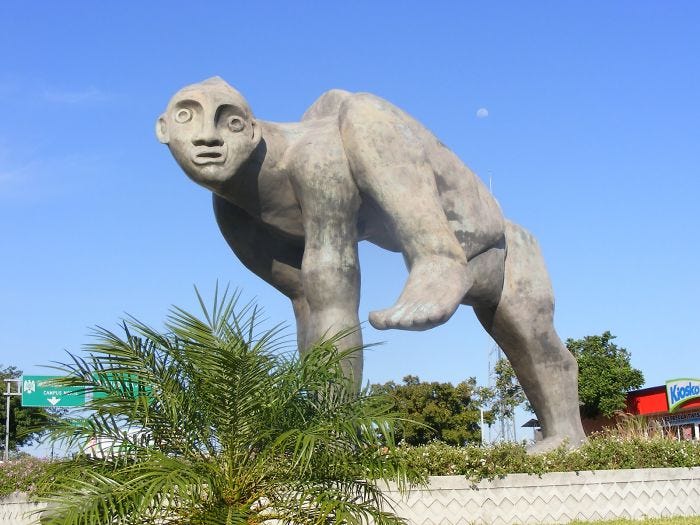
The point of ugly modern art, ugly music, degenerate culture, statues to honor incoherence, ect. Is NOT simply a twee or over-ironic subversion for subversion’s sake…
It is, and the artists will say this themselves, meant to “challenge” the viewer…
Ie. It is a conscious assault on the culture making, loyalty forming, history teaching, and values enforcing role of art in the white dominant ethnicity.
In the exact same manner that Statues to war-heroes, glory, victory, the founders, Civic Heroes ect. Organize a people and orient them towards their conception of themself, loyalty and virtue…. Statues to non-sense, incoherence, confusion, perversion, and alienation purposefully exist to disrupt and to destroy that coherence and ethnic civitas.
Likewise whereas 18th, 19th and early 20th century superhit songs like Rule Britannia, Scotland the Brave, I wish I was in Dixie, Erika, The Maple Leaf Forever, Etc. all came about and had the function of creating and reinforcing certain ethnic, national, and particularist visions of their peoples such that all of them have served as rallying calls or marching songs.
Once music was centralized in the hands of corporations and more importantly the centralization of “conversation” news corporations, there has been an aggressive force to artificially push degrading, divisive, and DUMB works… Largely with manufactured “controversies” which are never actually new or actually controversial.
Rather “Controversial” works exist not to explore thematic or dark subjects… but to act as demoralizing ChimpFests that create symbolic confusion and create ethnic demoralization,
.
Notice how there is not even a beat, melody, rhyme, chord, catching turn of phrase, or evocative sound…
I dare you to walk away, come back after an hour, and try to quote or ever hum a lyric of melody that is not the title itself.
Contrast even degenerate trash culture Icons like 3OH!3 or over-politicized black Shitlibery like Killer Mike’s “Reagan”, which both have decent enough quotes, and can be interpreted or enjoyed variously ironically, literally, etc. (many a Patrick Bateman-wannabe young Republican has listened to “Reagan” aspirationally) and you can see the point of “This is America” isn’t to be enjoyed or express something, or even be remembered, but to be a pure chimp out, a pure expression of ethnic resentment.
Childish Gambino’s bizzare meter-less melody-less undulations are the musical equivalent of the DEI fat black woman statues. The point is to be bad. Beauty or quality would detract from the expression of resentment and institutional power.
If it were well made or had merit of it’s own, then that would confuse the message.
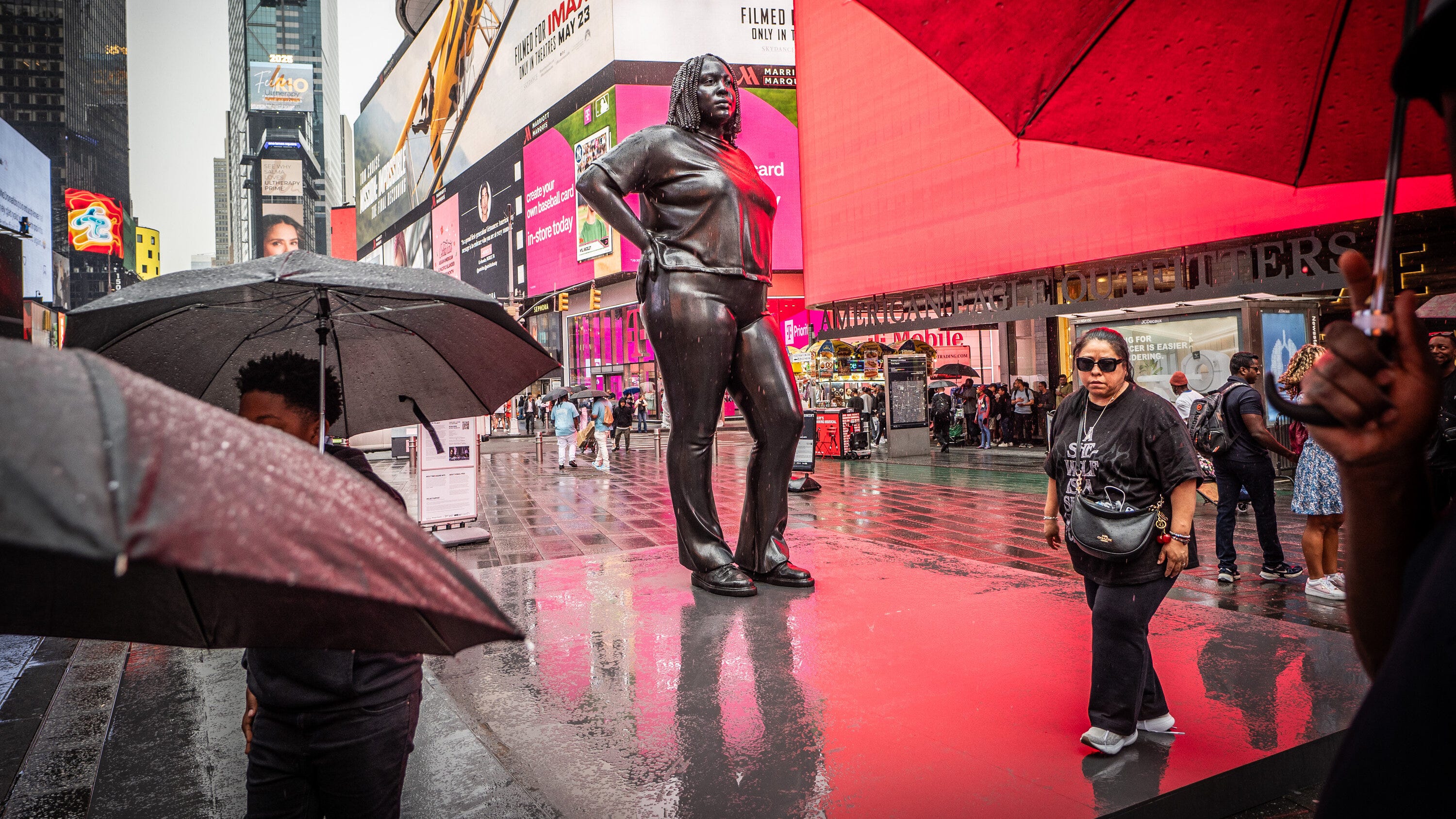
.
The point of these acts of cultural defacement and attacks auditory, statuary, cultural, and Architectural… whether that be Black Helen of Troy in the latest version of the Odyssey, or what they did to the Royal Ontario Museum:
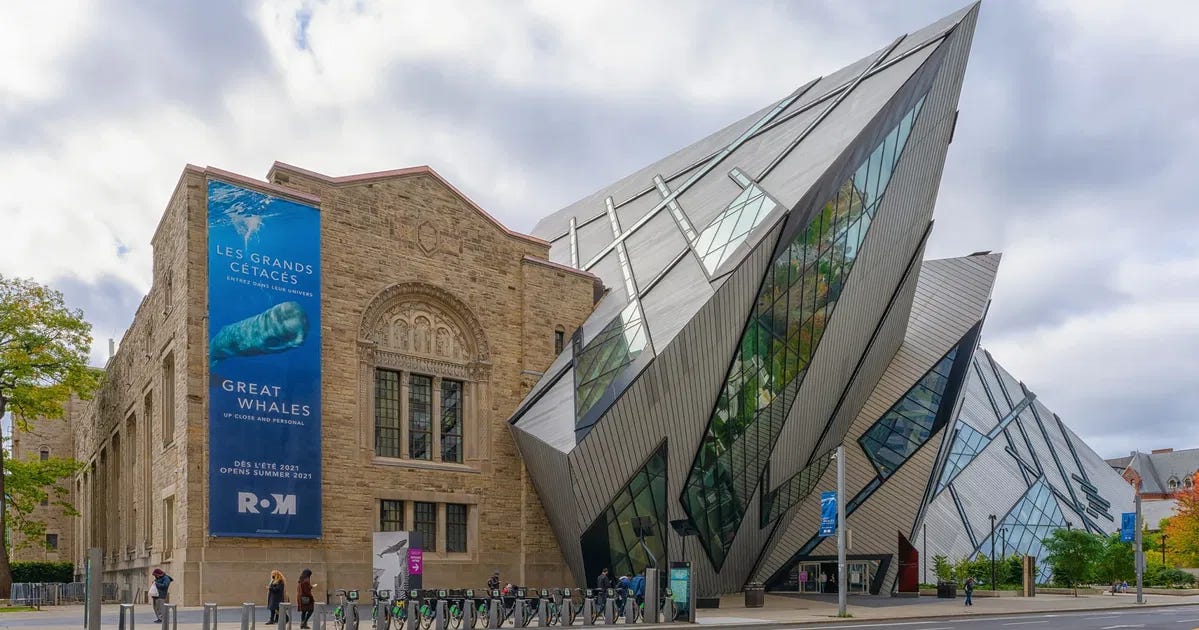
None of this is mere innocent self expression any more than interrupting a remembrance day parade with a Rap Concert would be mere “Festivity”.
The point of all these activities, all these ugly constructions, the destruction or active destroying of monuments, churches, ect.
It is to express ethnic hatred for the founding majority population and to destroy their core cultural organization and enforcement. Just as removing the statue of victory from Rome was not even because Christianity cannot tolerate personification of concepts or classical Gods themselves… There are actually quite a few Mosaics, statues, and artwork depicting the Grecian Gods within the Vatican.
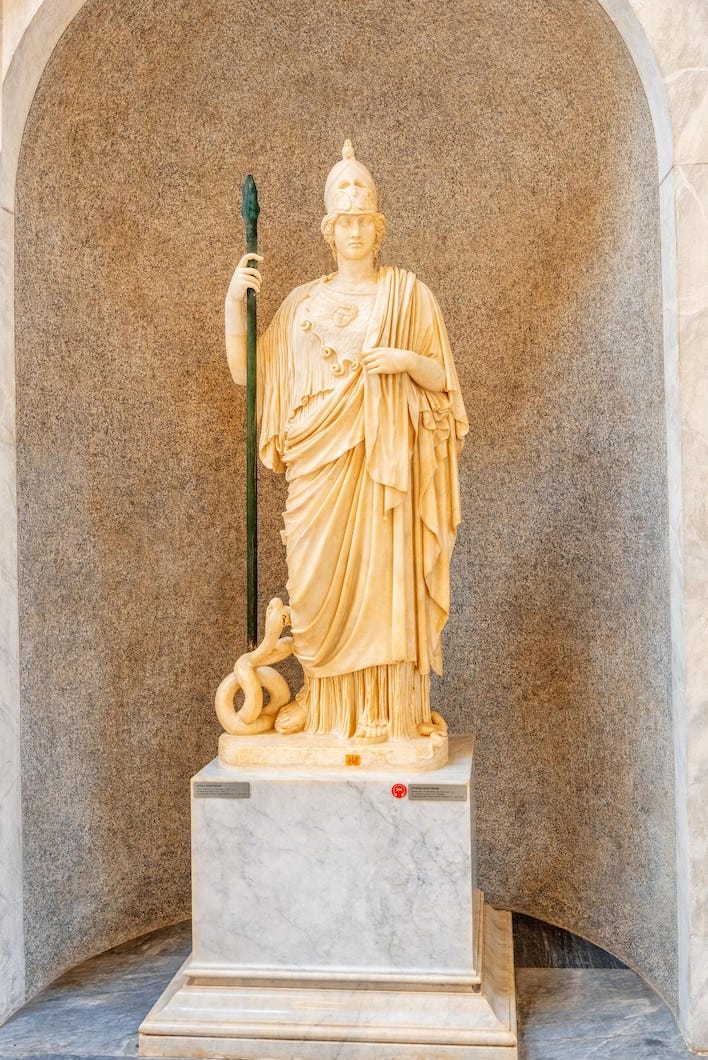
Rather just as early Christian icon destruction was motivated by ethnic hatred and spite for Ethnic Romans… And later Protestant Iconoclasm was motivated by ethnic hatred and spite for Mediterranean Political and Cultural encroachment (the protestant reformation almost exactly follows the Maximum limits of the Roman empire with odd counter examples like Ireland or Poland staying catholic out of their own ethnic hatreds of the English and Germans. Indeed the most violent Iconclasm in the low countries almost directly maps onto Julius Caesars’ apocalyptic genocide of the Belgae in modern Belgium and the Netherlands, and the subsequent wars back and forth over the territory)…
Modern Iconoclasm is likewise ENTIRELY an exercise in ethnic hatred, ethnic territory claiming, and purposeful attempts at cultural destruction to prevent basic institutions of loyalty, value hierarchy, reverence, reification, and idealization.
It is the exact same social dynamic as an enemy trying to capture your Colors on the field of battle so as to shame and break morale of the military unit they represent. That men can be replaced, but colors or eagles lost permanently shame and damage a unit. Such that depending on an era they may never recover the same Espirit D’Corp.
.
Symbols, icons, rally points, and sacred objects are the deep technology of national, military, cultural, and social organization. And for that to work their sacredness has to be enforced, and the often violent clashes over their meaning rewarded…
The same way a confused and pranking local who tried to steal the colors of a British Regiment in the 18th century out of a misplaced sense of humor, might be bayoneted by the guard on duty and the guard rewarded for his disemboweling of the pranking interloper.
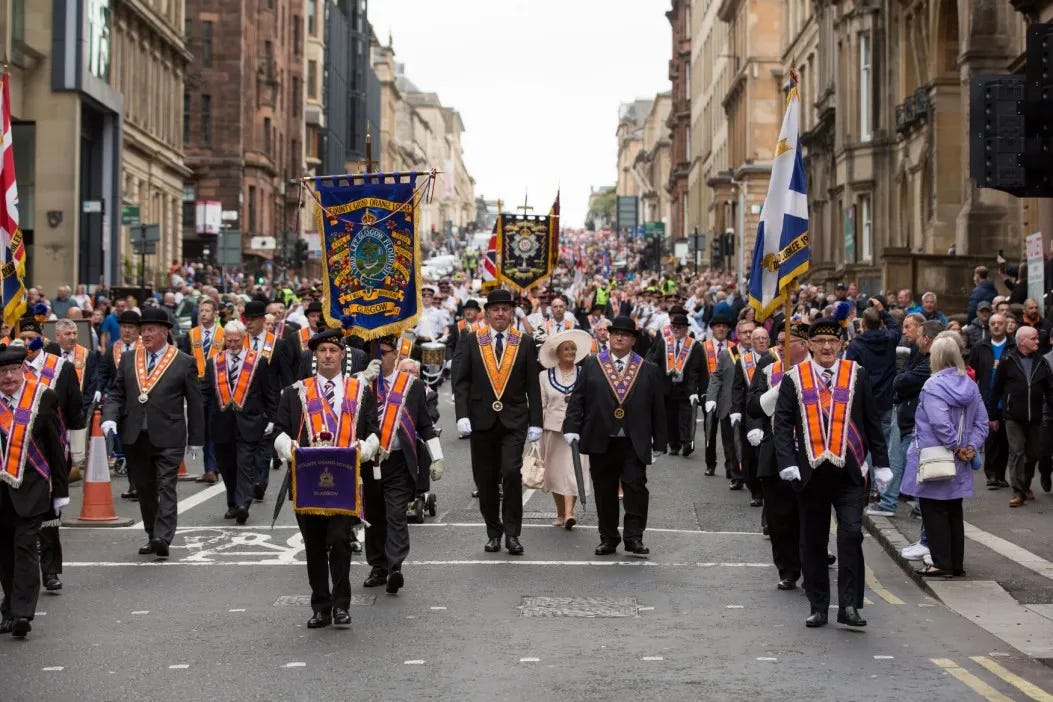
This is why the old service clubs, secret societies, and paramilitaries that lasted for hundreds of years like The Orange Order, or The Freemasons, or the Sons of the Confederacy…
All of them have sacred objects, songs, uniforms, and rituals to build that internal coherence.
Just like Military Regiments.
Indeed many even practice/practiced their own forms of military drill, rank structure, subordination, etc.
Because it works.
Rituals Work. Idols Work. Marching Songs Work. Drinking songs work. Uniforms work. Ceremonial Dress Works. Feasting Works. Exercise groups work. Napoleonic Eagles Work. Flags Work. Roman Style Bear-head outfits work. Italian Frescos work. Statues Work. Murals Work.
All of these rituals symbols create Espirit D’Corp. They create morale. They create an Ethos and rally point.
And that’s why your enemies are so keen to disrupt these.
Follow me on Twitter: @FromKulak
Tip:
BITCOIN: bc1qdhj7637sgcssxgxygjaa3ddljwy8tzg5mzw325

MONERO: 8AhA3g9hbtDcAJE5MPmeQsFwwGsf3H9fq9tC6giQ4a6vKnTXv4J4MivKXrPKDpXyEeNc9mfFejbq84kSWkC8pjuj18rAEij

Follow me on Twitter: @FromKulak
The reference to the second commandment is misleading. Reading the whole paragraph of the commandment shows that it's not the creation of images that is forbidden, but bowing down to and worshipping images, and making images for that purpose . It's a ban on idolatry. Indeed, God commanded people to carve many items, including Tabernacle & Temple accoutrements such as the Menorah, the altar, the pool (sea), swords, etc.
Here's the first two commandments, in Exodus 20 (ESV):
1 And God spoke all these words, saying,
2 “I am the Lord your God, who brought you out of the land of Egypt, out of the house of slavery.
3 “You shall have no other gods before me.
4 “You shall not make for yourself a carved image, or any likeness of anything that is in heaven above, or that is in the earth beneath, or that is in the water under the earth. 5 You shall not bow down to them or serve them, for I the Lord your God am a jealous God, visiting the iniquity of the fathers on the children to the third and fourth generation of those who hate me, 6 but showing steadfast love to thousands of those who love me and keep my commandments.
Grok adds:
Tabernacle:
Cherubim (heavenly beings): Two golden cherubim on the mercy seat/Ark of the Covenant (Exodus 25:18-22); additional cherubim embroidered/woven into the inner veil and curtains (Exodus 26:1, 31).
Menorah (lampstand): Hammered gold with almond blossoms, buds, flowers, and branches (Exodus 25:31-40; 37:17-24)—highly detailed botanical imagery.
Other elements: Embroidered designs on curtains; the High Priest’s garments included pomegranates (blue, purple, scarlet) alternating with golden bells around the hem (Exodus 28:33-34).
Key Examples from Solomon’s Temple (1 Kings 6–7; 2 Chronicles 3–4)
Cherubim: Large olive-wood cherubim in the inner sanctuary; carved figures of cherubim on walls throughout the inner and outer sanctuaries, alongside palm trees and open flowers (1 Kings 6:23-29).
Walls and panels: Carved with cherubim, palm trees, open flowers, lions, and wreaths (1 Kings 6:29, 35; 7:36).
Bronze Sea and stands: Twelve oxen supporting the large basin (“sea”); cherubim, lions, palm trees, and wreaths engraved on the movable stands and panels (1 Kings 7:23-29, 36).
Pomegranates: Hundreds of ornamental pomegranates on the capitals of the two bronze pillars (Jachin and Boaz)—specifically 400 in total (1 Kings 7:18-20, 42; 2 Chronicles 4:13). Also on the High Priest’s robe.
Golden vine with grape clusters: A large, prominent golden vine (or vines) with massive grape clusters (some described as tall as a man) hung as a major decoration, notably over/above the entrance to the sanctuary or on the façade. People added golden leaves, berries, or clusters as offerings, and it was a striking visual feature.
These were all commanded or approved by God as part of proper worship and temple decoration—symbolic, beautiful, and instructional, but never bowed to or served as deities. Other biblical art includes the bronze serpent (Numbers 21:8-9, later destroyed when it became an idol—2 Kings 18:4)
I’m glad this is back up. I was halfway through when it disappeared last time!